what led to the flood of irish immigrants in the 1840s
Clearing to the United States
The pace of immigration accelerated in the 1840s and 1850s, as people from Europe sought land, freedom, opportunity, and jobs in the U.s..
Learning Objectives
Summarize the patterns of clearing into the United states during the first two-thirds of the nineteenth century
Cardinal Takeaways
Key Points
- Immigration to the United States from Britain, Ireland, Germany, and other parts of western Europe increased outset in the 1830s.
- Most immigrants were attracted by the cheap farmland bachelor in the Us; some immigrants were artisans and skilled factory workers attracted by the first stage of industrialization.
- Many Irish immigrants became unskilled workers on infrastructure projects and in factories; many German language immigrants became farmers and craftsmen.
- The California gold blitz of 1849 rapidly expanded the population of the new territory, attracting thousands of immigrants from Latin America, China, Australia, and Europe.
- Between 1841 and 1850, clearing nearly tripled, totaling 1,713,000 immigrants.
- Equally German language and Irish immigrants poured into the The states in the decades preceding the Civil State of war, native-born laborers institute themselves competing for jobs with new arrivals who were more likely to work longer hours for less pay.
Primal Terms
- infrastructure: The basic facilities, services, and installations needed for the functioning of a community or order.
- industrialization: A process of social and economical change whereby a human club is transformed through manufacturing and advances in engineering, particularly with the development of big-calibration energy and metallurgy production.
Clearing in the Nineteenth Century
At that place was relatively niggling immigration into the United States from 1770 to 1830. Large-calibration clearing resumed in the 1830s from Britain, Ireland, Germany, and other parts of western Europe, and the pace of immigration accelerated in the 1840s and 1850s. Most immigrants were attracted past the cheap farmland available in the United States; some immigrants were artisans and skilled manufacturing plant workers attracted by the first phase of industrialization. Poor economic conditions in Europe drove many people to seek land, freedom, opportunity, and jobs in the new nation of America.
Clearing from Europe
Many new members of the working class came from the ranks of these immigrants, who brought new foods, community, and religions. The Roman Catholic population of the United States, fairly small earlier this menstruation, began to swell with the arrival of the Irish and the Germans. Many people immigrated from Ireland to work on infrastructure projects such as canals and railroads and settled in urban areas. Many Irish went to the emerging material mill towns of the Northeast, while others became longshoremen in the growing Atlantic and Gulf port cities. Well-nigh half of the immigrants from Germany headed to farms, especially in the Midwest and Texas, while the other half became craftsmen in urban areas.
Between 1841 and 1850, immigration nigh tripled, totaling i,713,000 immigrants. The bully potato famine in Ireland (1845–1849) drove the Irish to the The states in big numbers; they emigrated straight from their homeland to escape poverty and death. The failed Irish revolutions of 1848 brought many intellectuals and activists to exile in the United States.
The California Golden Rush
By 1848, thousands of California'southward residents had gone north to the gold fields with visions of wealth, and in 1849, thousands of people from effectually the world followed them, marking the starting time of the aureate rush. The California gold blitz speedily expanded the population of the new territory, attracting thousands of immigrants from Latin America, China, Australia, and Europe; information technology too prompted concerns near immigration, especially from China.
Foreigners were mostly disliked, especially those from South America. The nigh discriminated against, notwithstanding, were the thousands of Chinese immigrants. Eager to earn money to transport to their families in Hong Kong and southern Mainland china, they rapidly earned a reputation as frugal and difficult workers who routinely took over diggings others had abandoned as worthless and worked them until every scrap of gold had been constitute. Many American miners, oft spendthrifts, resented their presence and discriminated against them, believing the Chinese, who represented about 8 percent of the most 300,000 who arrived, were depriving them of the opportunity to make a living.
In 1850, California imposed a tax on foreign miners, and in 1858, information technology prohibited all immigration from Cathay. Those Chinese who remained in the face of the growing hostility were oftentimes beaten and killed, and some Westerners made a sport of cutting off Chinese men'due south queues, the long braids of hair worn down their backs. In 1882, Congress took up the ability to restrict immigration by banning the farther immigration of Chinese.
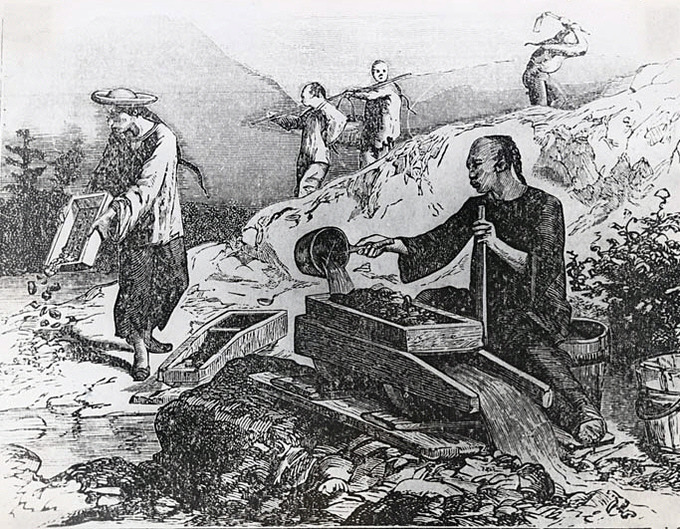
Chinese gold miners in California: One impetus for immigration was the aureate rush of 1849, which brought to California thousands of immigrants from Latin America, Mainland china, Australia, and Europe.
Immigration and Worker Exploitation
As German and Irish immigrants poured into the United States in the decades preceding the Ceremonious War, native-born laborers plant themselves competing for jobs with new arrivals who were more likely to work longer hours for less pay. As a result, many wage workers in the North were largely hostile to immigration. In Lowell, Massachusetts, for example, the daughters of New England farmers encountered competition from the daughters of Irish farmers suffering the effects of the potato dearth; these immigrant women were more than likely to be exploited past employers, working for far less money and enduring worse conditions than native-built-in women. Male German language and Irish immigrants too competed with native-built-in men. Germans, many of whom were skilled workers, took jobs in furniture making. The Irish provided a gear up source of unskilled labor needed to lay railroad tracks and dig canals. American men with families to support grudgingly accepted low wages in order to keep their jobs. As work became increasingly deskilled, no worker was irreplaceable, and no one's job was rubber.
Irish Clearing
A second moving ridge of Irish Cosmic immigration began in the 1840s following the spud famine in Republic of ireland.
Learning Objectives
Hash out the waves of Irish gaelic immigration into the United States
Fundamental Takeaways
Key Points
- The starting time wave of Irish gaelic clearing, which occurred earlier the American Revolution, consisted more often than not of Protestants from Ulster who settled in the American interior. Descendants of this showtime wave chosen themselves "Scotch-Irish."
- A second moving ridge of Irish gaelic Catholic immigration began in the 1840s following the white potato famine in Ireland. By 1890, ii of every 5 Irish-born people were living abroad.
- Most of the new Irish Cosmic immigrants worked as unskilled laborers. In the Northeast, they worked in textile mills in emerging industrial cities. In the interior of the country, they worked on infrastructure projects such equally canals and railroads.
- Native-built-in laborers establish themselves competing for jobs with new Irish arrivals who were more likely to piece of work longer hours for less pay; the resulting job competition acquired widespread discrimination against Irish immigrants.
Key Terms
- potato famine: A flow of mass starvation, disease, and emigration in Ireland betwixt 1845 and 1852.
- unskilled labor: Of a person or workforce: not having specific technical training.
Early on Irish Immigrants
Protestant Irish gaelic immigrants from Ulster had been coming to British North America since the 1700s, and many had settled in the upland areas of the American interior. They participated in the American Revolution in large numbers and were a well-established community by the 1840s, when a second moving ridge of Irish immigration began. At that time, descendants of the first moving ridge of Irish gaelic immigration began to refer to themselves equally "Scotch-Irish" to distinguish themselves from the newly arrived immigrants.
The White potato Famine
The Irish murphy dearth (1845–1849) destroyed much of the potato crop in Ireland and sent the unabridged country into starvation. Many emigrated to America in order to escape poverty and expiry. These new Irish immigrants were primarily Catholic, and almost became unskilled workers who settled in urban areas in the Northeast and Midwest such as Boston, New York, and Chicago. Many Irish went to the emerging textile- mill towns of the Northeast; some also migrated to the interior of America to work on large-calibration infrastructure projects such equally canals and railroads.
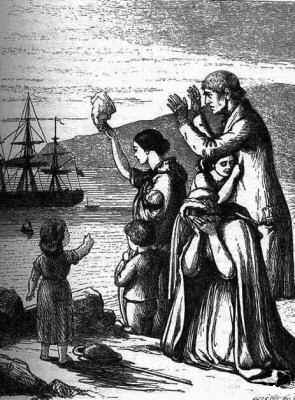
Emigrants leaving Ireland: Irish immigration brainstorm in the mid-eighteenth century and intensified during the corking potato famine of 1845–1849.
Past 1840, emigration had become a massive, relentless, and efficiently managed national enterprise. Including those who moved to Britain, between ix and 10 million Irish people emigrated after 1700. The total menstruation was more than than the population at its historical peak in the 1830s of 8.five one thousand thousand. From 1830 to 1914, most 5 meg Irish traveled to the Usa alone. In 1890, two of every five Irish-born people were living abroad. Past the 2000s, an estimated 80 1000000 people worldwide claimed some Irish descent; amid them are l million Americans who merits "Irish" equally their primary ethnicity.

Graph of total population of Ireland: This graph shows the sharp decline in population in Ireland beginning in 1840. Past 1855, almost two million Irish had emigrated.
Discrimination and Assimilation
Equally Irish immigrants poured into the United States in the decades preceding the Civil State of war, native-born laborers found themselves competing for jobs with new arrivals who were more likely to piece of work longer hours for less pay. In Lowell, Massachusetts, for case, the daughters of New England farmers encountered contest from the daughters of Irish gaelic farmers suffering the furnishings of the potato dearth; these immigrant women were more hands exploited by employers, working for far less money and enduring worse atmospheric condition than native-born women. Male Irish gaelic immigrants too competed with native-born men. The Irish provided a prepare source of unskilled labor needed to lay railroad tracks and dig canals. American men with families to support grudgingly accepted low wages in guild to keep their jobs.
As work became increasingly deskilled, no worker was irreplaceable, and no i's job was safe. The resulting job competition caused a general hostility toward Irish immigrants. Nineteenth-century Protestant American "nativist" discrimination against Irish Catholics reached a peak in the mid-1850s, when the Know-Zero Party tried to oust Catholics from public office. Much of the opposition came from Irish Protestants, as in the 1831 riots in Philadelphia, Pennsylvania. During the 1830s, riots for control of job sites bankrupt out in rural areas between Irish gaelic and local American work teams competing for construction jobs. Subsequently 1860, many Irish sang songs about "NINA signs" reading, "Help wanted—no Irish demand apply."
Effects on American Culture
The Irish had a huge affect on America as a whole. Fifty-fifty today, many major cities in the United States retain a substantial Irish American community. Massachusetts mill towns such as Lawrence, Lowell, and Pawtucket attracted many Irish women in item. The anthracite-coal region of northeastern Pennsylvania saw a massive influx of Irish gaelic during this time period; weather in the mines somewhen gave rise to groups and secret societies such as the Molly Maguires. As they alloyed, Irish Americans contributed to U.South. culture in a wide diversity of fields, such every bit the fine and performing arts, film, literature, politics, sports, and organized religion.
German language Clearing
Between 1820 and World War I, many German political refugees came to America post-obit a series of German revolutions.
Learning Objectives
Summarize the political significance of German language clearing in mid-nineteenth century America
Primal Takeaways
Key Points
- The largest flow of German immigration to America occurred betwixt 1820 and World State of war I, during which fourth dimension well-nigh six 1000000 Germans immigrated to the United States. Roughly one-half of High german immigrants settled in cities and became skilled workers and entrepreneurs, while the other half established large farms in the Midwest.
- In the mid-nineteenth century, German immigrants formed the largest incoming group to America.
- Cities such as Milwaukee, Cincinnati, and St. Louis attracted big High german populations, and many cities had neighborhoods named in reference to this German heritage.
- Sentiment amidst German Americans was largely antislavery, and hundreds of thousands of German Americans volunteered to fight for the Spousal relationship in the American Civil War.
Primal Terms
- entrepreneur: A person who organizes and operates a business organization venture and assumes much of the associated risk.
- brewing: The product of alcoholic beverages, such equally beer, past fermentation.
Clearing from Germany
The largest menstruum of German immigration to America occurred between 1820 and World War I, during which time nearly half dozen meg Germans immigrated to the Us. From 1840 to 1880, they were the largest group of immigrants to the United States. Following the Revolutions of 1848 in Federal republic of germany, a wave of political refugees fled to America who became known every bit "Forty-Eighters." They included professionals, journalists, and politicians. Prominent Xl-Eighters included Carl Schurz and Henry Villard.
Location of German Communities
The cities of Milwaukee, Cincinnati, St. Louis, Chicago, New York, and Baltimore were favored destinations of German immigrants. Many communities caused distinctive names suggesting their heritage, such as the "Over-the-Rhine" district in Cincinnati and the "German Village" in Columbus, Ohio. Milwaukee was once known as "the German Athens," and radical Germans trained in politics in the old country dominated the city'due south Socialists. Skilled workers produced many crafts, while entrepreneurs created the beer brewing manufacture; the nigh famous brands included Pabst, Schlitz, Miller, and Blatz.
While roughly half of German immigrants settled in cities, the other half established farms in the Midwest. From Ohio to the Plains states, a heavy presence of German heritage persists in rural areas today. Few Germans settled in the Deep South, autonomously from some in New Orleans.

German population in America, 1872
This map shows the large number of German Americans in the United States and their concentration in the northern region of the country.
Politics and Role in Society
Sentiment among German Americans was largely antislavery, especially among 40-Eighters. Hundreds of thousands of German Americans volunteered to fight for the Union in the American Civil War, making them the largest immigrant grouping to participate. Although just one in four Germans fought in all-German regiments, they created the public paradigm of the German language soldier.
Relatively few German language Americans held office, but the men voted later on they became citizens. In general during the Third Party System (1850s–1890s), the Protestants and Jews leaned toward the new Republican Political party and the Catholics were strongly Democratic. When prohibition was on the election, the Germans voted solidly against it. In the belatedly nineteenth century, many Germans in cities were socialists, and Germans played a meaning part in the labor-union movement.
The Germans worked hard to maintain and cultivate their language, especially through newspapers and classes in elementary and loftier schools. German Americans in many cities, such as Milwaukee, brought their potent support of education, establishing German-language schools and teacher-training seminaries (Töchter-Institut) to prepare students and teachers in High german-language preparation. By the late nineteenth century, the Germania Publishing Company—a publisher of books, magazines, and newspapers in High german—was established in Milwaukee.
"Germania" was the common term for German language-American neighborhoods and their organizations. Deutschtum was the term for transplanted German nationalism, both culturally and politically. Between 1875 and 1915, the German-American population in the United States doubled, and many of its members worked hard to maintain their culture. German was used in local schools and churches, while numerous Vereine—associations dedicated to literature, humor, gymnastics, and singing—sprang up in German-American communities. German Americans tended to support the German government'south actions, and, even after the United states of america entered World War I, they ofttimes voted for antidraft and antiwar candidates. Deutschtum in the Usa disintegrated after 1918.
Nativism
Nativism was an anti-immigration motion that favored those descended from the inhabitants of the original thirteen colonies.
Learning Objectives
Describe anti-immigrant sentiment in mid-nineteenth century America
Primal Takeaways
Key Points
- Nativists believed they were the true "Native" Americans, despite their being descended from immigrants themselves.
- In response to the waves of immigration in the mid-nineteenth century, Nativists created political parties and tried to limit the rights of immigrants. One Nativist organization, the "Lodge of the Star Spangled Banner," became known every bit the "Know-Nothings."
- Much Nativist sentiment was focused on Irish Americans, but German language and Chinese immigrants came under attack too.
Fundamental Terms
- Know-Nothings: A movement by the Nativist American political faction of the 1850s characterized past political xenophobia, anti-Cosmic sentiment, and occasional bouts of violence against the groups members opposed.
- American Party: A political party active in Connecticut in the early nineteenth century.
- Lodge of the Star Spangled Banner: An oath-bound underground society in New York City created in 1849 past Charles Allen to protest the rise of Irish, Roman Catholic, and High german immigration into the Usa.
Anti-Clearing Sentiments
The big numbers of immigrants that came from dramatically different cultures during the middle of the nineteenth century sparked a number of anti-immigration movements. The largest of these movements was nativism, which took its name from the "Native American" parties. In this context, "native" did not hateful ethnic or American Indian, but rather those descended from the inhabitants of the original British xiii colonies. Nativists objected primarily to Irish Roman Catholics because of their loyalty to the Pope and considering of their supposed rejection of the American ideal of republicanism. Nativism's prejudice was not exclusive to Irish gaelic Catholics, withal: German and Chinese immigrants also came nether attack during the second half of the nineteenth century.
As High german and Irish immigrants poured into the Us in the decades preceding the Civil War, native-born laborers also found themselves competing for jobs with new arrivals who were more likely to work longer hours for less pay. This chore competition resulted in increased hostility toward immigrants; equally piece of work became increasingly deskilled, no worker was irreplaceable, and no one's job was safe.
Nativist outbursts occurred in the Northeast from the 1830s to the 1850s, primarily in response to a surge of Irish Catholic immigration. In 1836, Samuel F.B. Morse ran unsuccessfully for mayor of New York Metropolis on a Nativist ticket, receiving only 1,496 votes. Following the Philadelphia Nativist riots in the spring and summer of 1844, the Order of United Americans, a Nativist fraternity, was founded in New York City.
The Know-Nothings
Past 1850, Charles B. Allen had founded a Nativist order called the "Social club of the Star Spangled Banner" in New York City. In order to join the Order, a human being had to be 21 years of age, a Protestant, a believer in God, and willing to obey without question the dictates of the Guild. Members became known as the "Know-Nothings" because, if asked in public, they claimed to know nothing almost the secret society. The anti-Cosmic Know-Nothings wanted to extend the corporeality of fourth dimension it took immigrants to become citizens and voters; they also wanted to forbid foreign-built-in people from always holding public office.
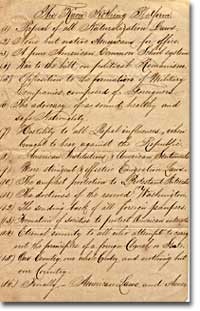
The Know-Nothings: The Know-Nothing Party's platform included the repeal of all naturalization laws and a prohibition against immigrants holding public office.
The American Party
The Nativists went public in 1854 when they formed the American Political party, which was especially hostile to the immigration of Irish Catholics and campaigned for laws to require longer wait time between clearing and naturalization. The laws never passed. It was at this fourth dimension that the term "nativist" kickoff appeared; opponents denounced them as "bigoted nativists." In the 1854 elections, Nativists won control of country governments in Massachusetts, Connecticut, Rhode Isle, New Hampshire, and California. They won elections in Maryland and Kentucky and took 45 percent of the vote in five other states. In 1856, Millard Fillmore was the American Party candidate for president and trumpeted anti-immigrant themes. Nativism caused much splintering in the political landscape
Immigrant Labor
Many of the economical gains in the The states during the nineteenth century were made possible by immigrant labor.
Learning Objectives
Describe the contribution clearing made to economical growth in nineteenth-century America
Key Takeaways
Key Points
- Immigration provided the population growth necessary for the booming American economy of the nineteenth century.
- Many immigrants came to the United States specifically for task opportunities that promised a improve life.
- Immigrant communities were attracted to a wide range of jobs: Irish gaelic immigrants largely became factory workers and laborers, while German language immigrants became skilled craftsmen, entrepreneurs, and farmers.
- The California gilt rush of 1849 provided some other reason for thousands of immigrants seeking opportunities to come to the United states.
Central Terms
- unskilled labor: Of a person or workforce: non having technical grooming.
- infrastructure: The bones facilities, services, and installations needed for the operation of a community or society.
Immigrant Labor
Immigrants of the nineteenth century flocked to urban destinations, making up the bulk of the U.S. industrial labor puddle. These new sources of labor greatly influenced the emergence of the steel, coal, automobile, textile, and garment industries, increasing production and enabling the Usa to leap into the front end ranks of the world's economies.
Many of the population and economic gains during the nineteenth century were made possible by clearing, equally hundreds of thousands of people came from Europe, China, and Latin America seeking the chore opportunities and the perceived prospect of a better life in America. Dissimilar immigrant groups tended to drift toward dissimilar occupations, depending on their background. The Irish provided mostly unskilled labor in factories, textile mills, and big infrastructure projects such as canals and railroads. Many Irish went to the emerging textile mill towns of the Northeast, while others became longshoremen in the growing Atlantic and Gulf port cities. Roughly half of the immigrants from Deutschland went to farms, particularly in the Midwest and Texas, while the other half became craftsmen and entrepreneurs in urban areas.

Poster by the Houston and Texas Railroad advertisement land for immigrants: Many immigrants were attracted to the Us by the availability of cheap farmland. In detail, big numbers of German immigrants became farmers in the United States.
The California Gilt Rush
In 1849, the California gold rush brought in more than than 100,000 would-be miners from the eastern United States, Latin America, China, Australia, and Europe. California became a state in 1850 with a population of most ninety,000. Many of the immigrants who came for the gold rush also stayed to piece of work on large infrastructure projects such as the railroads.
Exploitation and Discrimination
Equally German language and Irish immigrants poured into the United States in the decades preceding the Ceremonious State of war, native-born laborers found themselves competing for jobs with new arrivals who were more likely to work longer hours for less pay. In Lowell, Massachusetts, for example, the daughters of New England farmers encountered contest from the daughters of Irish farmers suffering the effects of the white potato famine; these immigrant women were willing to work for far less and endure worse atmospheric condition than native-born women. Male person High german and Irish gaelic immigrants also competed with native-born men. Germans, many of whom were skilled workers, took jobs in furniture making. The Irish gaelic provided a ready source of unskilled labor needed to lay railroad tracks and dig canals.
American men with families to support grudgingly accepted low wages in order to continue their jobs. As piece of work became increasingly deskilled, no worker was irreplaceable, and no 1's job was safe. The resulting competition over jobs led to increased hostility from many native-built-in Americans toward immigrants during the nineteenth century.
Source: https://courses.lumenlearning.com/boundless-ushistory/chapter/immigration/
0 Response to "what led to the flood of irish immigrants in the 1840s"
Post a Comment